

The first ever Astronomy Higher Practical Qualification (HPQ) in the UK, piloted by the Royal Astronomical Society (RAS), is coming to an end this month.
It has been a hugely successful trial as an alternative to GCSE Astronomy, increasing student retention from 15 per cent in the traditional GCSE pathway to 54 per cent.
The qualification empowers students to take ownership of their learning by choosing an astronomy topic that genuinely interests them and developing a related artefact, such as a model, application, or tool.
The course structure is flexible and inclusive. Students work through a set of milestones but complete the qualification at a pace suited to their schedules. This adaptability makes the programme more accessible to diverse learners.
It began in September 2024 and has been co-taught by RAS Education and Outreach Officer Lucinda Offer and Professor Kevin Walsh, from Westminster School.
The first year of the course focused on students writing a 2,500-word research paper, supported by logbooks and presentations, while in year two students have been tasked with completing an astronomical or space science artefact.
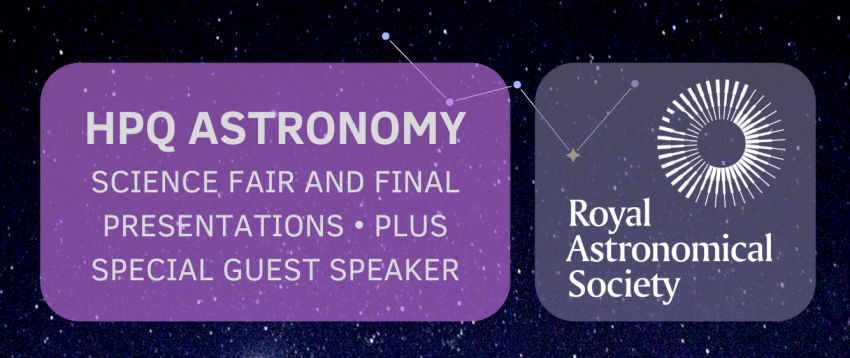
They will present their final projects at the HPQ Astronomy Science Fair on the 19 and 26 March. The students will also answer questions about their work and act as junior science communicators.
RAS Fellows are warmly invited to come along on either or both days to hear from the students and celebrate the culmination of the HPQ Astronomy pilot programme. On the 26 March there will also be a talk from Julian Sommer FRAS, a PhD student in Cosmology at Ludwig Maximilian University in Munich.
Julian will join the students remotely to speak about his pathway into astrophysics, including how he came to pursue research in cosmology and the experiences that shaped his journey to becoming a scientist. His talk is titled ‘Beyond the Pendulum: From Sign Making and Struggling with Math to Researching the Cosmos’.
To find out more, click here.
Media contacts
Sam Tonkin
Royal Astronomical Society
Mob: +44 (0)7802 877 700
Lucinda Offer
Royal Astronomical Society
Notes for editors
About the Royal Astronomical Society
The Royal Astronomical Society (RAS), founded in 1820, encourages and promotes the study of astronomy, solar-system science, geophysics and closely related branches of science.
The RAS organises scientific meetings, publishes international research and review journals, recognises outstanding achievements by the award of medals and prizes, maintains an extensive library, supports education through grants and outreach activities and represents UK astronomy nationally and internationally. Its more than 4,000 members (Fellows), a third based overseas, include scientific researchers in universities, observatories and laboratories as well as historians of astronomy and others.
The RAS accepts papers for its journals based on the principle of peer review, in which fellow experts on the editorial boards accept the paper as worth considering. The Society issues press releases based on a similar principle, but the organisations and scientists concerned have overall responsibility for their content.
Keep up with the RAS on Instagram, Bluesky, LinkedIn, Facebook and YouTube.
Download the RAS Supermassive podcast